
What actually happens when rain pushes an Oheka Castle ceremony inside? A walk through the call, the re-set, the guest messaging and the timeline that follows.

You’ve picked the Formal Gardens, or the lawn, or the spot overlooking the water. You can already see the walk down the aisle in good light. And somewhere in the back of your mind, a weather app is open.
If you’re a Nassau County couple eyeing Oheka Castle, or a family weighing a lawn ceremony closer to home, most of the worry has little to do with getting wet. It comes down to whether the indoor version will feel like the day you planned or the day you settled for. We’re a Syosset-based event planner, and here’s how we think about that move: who decides, what gets rebuilt, and how the rest of the day holds its shape. First, what Oheka itself says.
Per Oheka’s FAQ, ceremonies are held outdoors in the Formal Gardens if the weather permits and moved indoors if it doesn’t. That’s the whole policy, in a sentence. The castle lists four outdoor ceremony spots (the Formal Gardens, Upper Lawn, Great Lawn and Upper Great Lawn) and every one of them depends on the sky. Indoors, the options include the Grand Ballroom, the Formal Dining Room and the Terrace Room.
A note for Nassau County readers: Oheka is a 1919 chateau in West Hills, NY, which sits in Suffolk County, so for many North Shore families it means guests heading east for the day. That matters when rain changes the plan, because everyone is already in motion.
What the policy doesn’t tell you is how the move actually works. That’s the part worth understanding before you book.
Start with the question most couples don’t think to ask: when does the call have to be made, and by whom? We can’t give you Oheka’s cutoff, and anyone quoting you a number without checking with the venue is guessing. Ask your venue contact directly, then get the answer into your timeline in writing.
Once you know the deadline, decide ahead of time who holds the decision. It might be you, your parents, or us with the venue weighing in. What matters is that it isn’t a group text at the last minute with six opinions and a radar map. We like to agree on a check-in point and a clear yes-or-no trigger long before the wedding week.
Debbie spent more than 12 years as a Director of Sales and Events on the catering side, and she has seen what a late decision looks like from inside a banquet operation. The later the call, the more has to be rebuilt with guests already arriving. One rainy-day Oheka wedding featured on Ruffled shows how that plays out: the ceremony was already set up outdoors, guests were showing up, and the team moved it inside anyway. It worked, and it looked romantic. It also meant moving everything while the guest list walked in.
That’s the argument for deciding early and calmly. A designed Plan B is a decision you’ve already made, with the chairs, flowers and music assigned to a spot, so the day itself is just execution. If you’d rather not carry that decision alone, that’s what day-of coordination is for. Donna, our day-of team member, is named in client reviews for keeping the timeline on track so families can actually enjoy the day.
The difference between a backup and a second plan is whether anyone designed it. Most outdoor ceremonies get a full treatment: an aisle, a focal point, flowers, a sound check. The rain version often gets “we’ll put chairs in the ballroom.” Guests feel that gap even if they can’t name it.
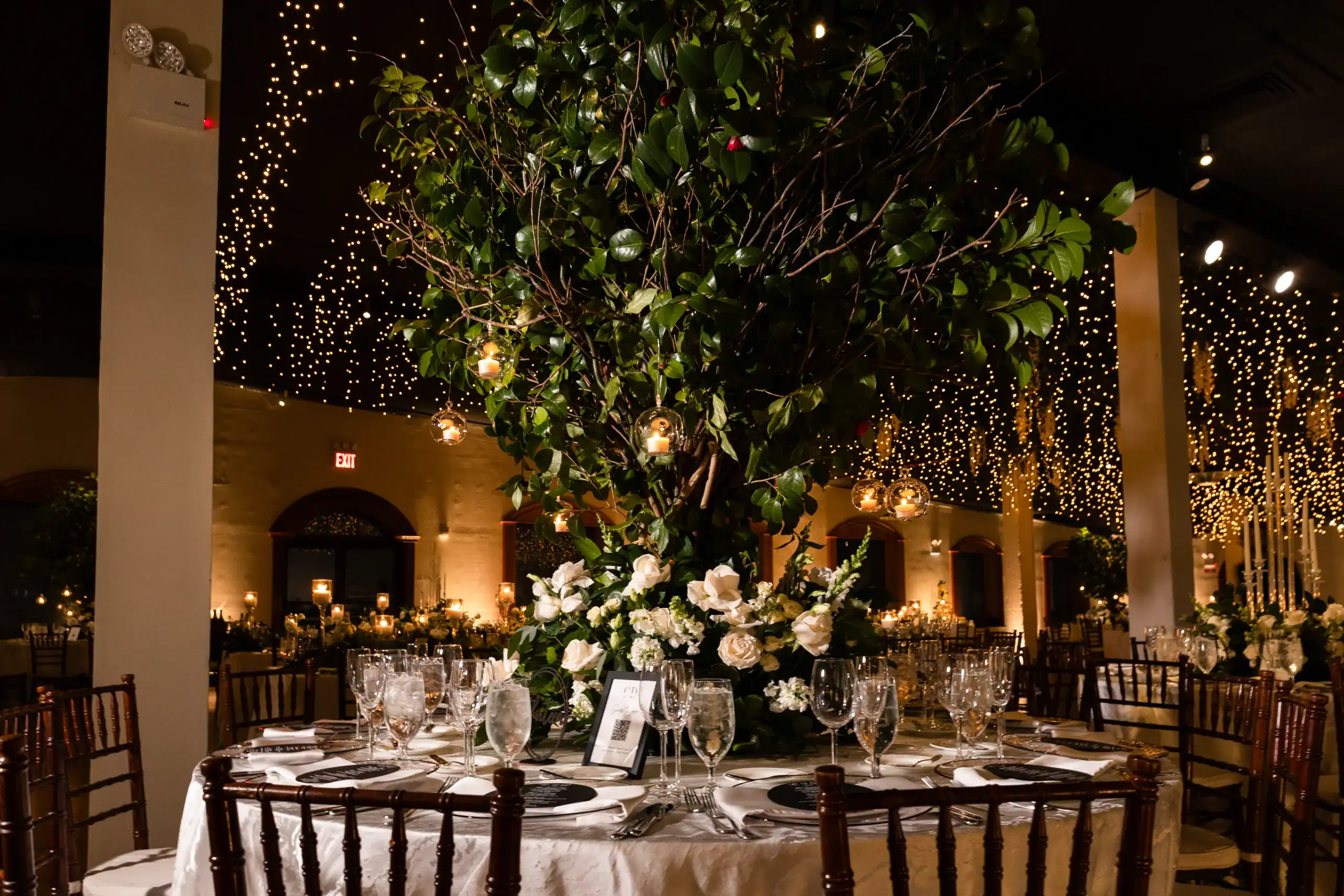
Oheka’s interiors are grand enough to carry a ceremony, and third-party guides call an indoor ceremony there “not a downgrade.” But a ballroom doesn’t style itself. Ask where the aisle runs, where you’ll stand in relation to the windows, how your officiant will be heard, and where the music cue comes from. Candlelight, lighting that suits the room and flowers scaled to the space can make it look intended from the start. We sketch that version during design, not the week of.
Room size matters too. The Grand Ballroom seats up to 200 and the Terrace Room up to 400, though you should confirm both numbers and any ceremony layouts with Oheka directly. If your guest list sits near the line, you want to learn that while planning, not while folding chairs are coming out.
Two of our client reviews stick with us here. One wedding client said guests were captivated by the ambiance and the smooth transition. Another said we handled deliveries, measurements and lighting, and solved problems before she knew they existed. That’s the mindset for a rain plan: measure the room before you need it.
Want live answers?
Connect with a Debbie Hart Celebrations expert for fast, friendly support.
Rain gets the blame, but the real work starts after the decision. Move a ceremony inside and you’ve also moved the guests, the music, the photographer’s light, the caterer’s path and the clock. The cocktail hour meant for the terrace now needs a roof, and the room where you just said “I do” may need to become a reception room.
The same chain reaction shows up with bar mitzvahs and bat mitzvahs. A ceremony and a celebration are two events with a handoff in between, and weather can scramble that handoff: arrivals, photos, entrances, the moment the party opens up. For Nassau County families, top venues book quickly for school-year Saturday nights, so there’s rarely a second date to fall back on. Planning the handoff is the job, wherever the ceremony happens.

Think through the sequence the way a catering manager would. If the ceremony takes over a room that was going to host the reception, that room has to be reset while your guests are somewhere else. That somewhere else needs enough space, bars and staff to feel like a party and not a waiting area. Ask your venue which room doubles as what, and how long a flip takes.
This is where Debbie’s catering background earns its keep. She knows what a banquet team needs to turn a space, and she builds the timeline around that instead of assuming the room resets itself. We write the weather version of the timeline next to the sunny one, so when the call is made, the new schedule already exists and every vendor has a copy.
Then there are your guests. People traveling from Nassau County out to Huntington shouldn’t learn about a room change by watching everyone else walk the wrong way. Decide in advance how word gets out: a sign at the entrance, ushers, a text to the group, a line in your welcome note. It sounds small, but it’s what makes a day feel run instead of rescued.
Last, the music. Debbie’s husband, Richie Hart, brings the entertainment side, so processional, doors-open and first-song cues can be coordinated within our own team. Reviewers have told us we work seamlessly with caterers and other vendors, and that’s exactly what a room flip depends on.
Do I need a wedding planner if the venue has a coordinator? A venue coordinator looks after the venue. We look after your whole day, including vendors who aren’t on the venue’s payroll. Plenty of couples are happy leaning on venue staff, and some have felt the venue’s team effectively served as their planner. Others hired outside help after slow replies to their concerns. Either can work. The question is who owns your full timeline when it rains.
Is Oheka Castle in Nassau County? No. It’s in West Hills, NY, in the Town of Huntington, Suffolk County. For our families in Sea Cliff, Bayville, Glen Head and Munsey Park, that means a trip east, so build your guest messaging and arrival plans with that in mind.
Does the same rain-plan thinking apply to venues closer to home? Yes. Waterfront lawns along Hempstead Harbor and estate grounds on the North Shore deal with wind and rain, and any ceremony on grass needs a second plan that someone has designed. We approach weddings, bar mitzvahs, bat mitzvahs and other mitzvahs the same way: map the handoff, name the decision-maker, and write the weather timeline early.
Do event planners need a license in New York? Generally, no state license is required, and certifications like CMP and CSEP are voluntary. That puts the weight on track record, so read reviews, ask for references, and pay attention to how an event planner answers questions like the ones above. A good party planner should be able to walk you through a rainy Saturday without hesitating.
Rain at an estate or waterfront ceremony is a scheduling problem you can solve ahead of time. Know who makes the call and when, design the indoor version as carefully as the outdoor one, and write the cocktail hour and reception reset into the timeline before anyone needs it. Do that, and a forecast change becomes a different version of your day instead of a lesser one.
Whether you need a wedding planner for an Oheka Castle date, an event planner for a bar or bat mitzvah in Nassau County, or a party planner who’ll ask the awkward weather questions early, Debbie Hart Celebrations is glad to talk it through. Debbie calls herself a Party Therapist for a reason, so no question is too small. Call or text 516-524-6266 and tell us what’s on your calendar and where the lawn is.
Summary:

Article details:
Share:
